
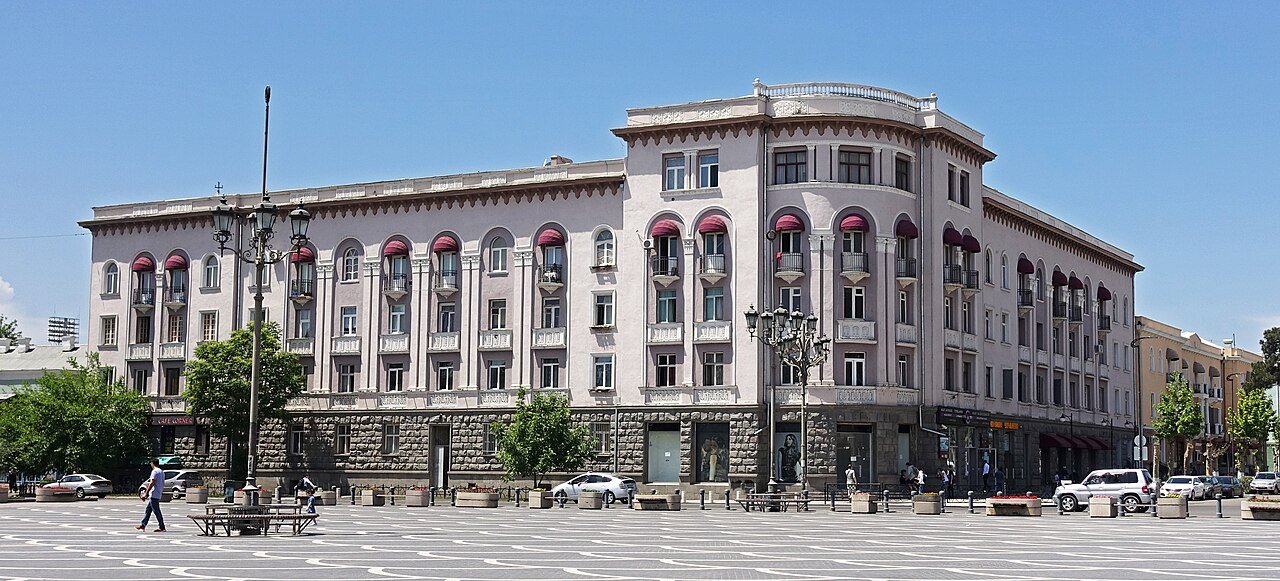
How New Rustavi Differs from Old Rustavi
New Rustavi is the more modern part of the city compared to Old Rustavi: wider avenues, more greenery in the courtyards, better-developed infrastructure. This is where most new construction and the properties investors and relocating families consider are concentrated.
History and character
Old Rustavi was laid out in 1944; housing in the new part began going up in 1955, as the plant needed ever more workers. Soviet block housing predominates, in numbered microdistricts, many with renewed facades (Wander-Lush). The city grew from 62,395 people in 1959 to 98,210 in 1970 and 158,661 in 1989.
After 1991 it fell to 116,384 (2002); the 2024 census counted 132,047 in all of Rustavi. The district is called a "sleeping city": many residents commute to Tbilisi.
What to see
Few tourist sights; the interest is architectural.
- Soviet microdistricts — postwar mass housing, many with renewed facades.
- Hotel Rustavi on Megobroba ("Friendship") Street — opened 1 May 1989, Brutalist.
- The Park of Culture and Rest — about 30 hectares along the Mtkvari with a lake; a walk around it takes about an hour.
- Rustavi motor circuit — the last permanent racetrack built in the USSR, rebuilt in 2011–2012.
Life and economy
The city lived on metallurgy, cement and chemicals, with about 90 large and medium plants in Soviet times. After 1991, Wikipedia says, 65% of residents lost their jobs; in the 2010s industry and employment partly recovered. Minibuses to Tbilisi leave the square by the Central Station about every 10–15 minutes and take about 50 minutes (Wander-Lush). The city has three universities and a song and dance ensemble founded in 1968.
Housing market: what is known and what is not
There is no public price data for New Rustavi; broker reviews quote city-wide ranges without method or date, so I do not repeat them. One guide says new buildings were going up in the 11th and 20th microdistricts (completion unconfirmed), which does not prove that new construction is concentrated here. Check in advance:
- the building's condition: facade, roof, lift, panel joints;
- for a new build, actual handover dates and stage of completion;
- what comparable flats in the same microdistrict are asking.
Frequently Asked Questions
How does New Rustavi differ from Old Rustavi?
New Rustavi is on the right bank, closer to Tbilisi, built from 1955 as block microdistricts. Old Rustavi, on the left bank, was planned in 1944: industry, administration, Stalinist Empire style.
How do I get from Tbilisi to New Rustavi?
About 25 km. Per Wander-Lush, minibuses leave the square by the Central Station every 10–15 minutes, 7:00–23:00, taking about 50 minutes.
Can I buy a flat in New Rustavi?
There is no open data on prices or deals. The general procedure is on the "How buying works" and "Property taxes" pages; have a specific flat checked by a local lawyer.
Sources: Wikipedia (en): Rustavi · Wikipedia (ru): Rustavi · Wikipedia (ka): Rustavi · Wander-Lush: things to do in Rustavi · OnlyByLand: Rustavi, Georgia · Tbilisi Trip: Rustavi and industrial Georgia · CityPopulation.de (Geostat census 2024): cities of Georgia
Other Rustavi Districts
Before you buy
Rules that apply across Georgia, whichever city you pick:
Market news · New Rustavi
A short summary of publications from open sources, prepared with AI; not legal or financial advice. Please check the original source.