
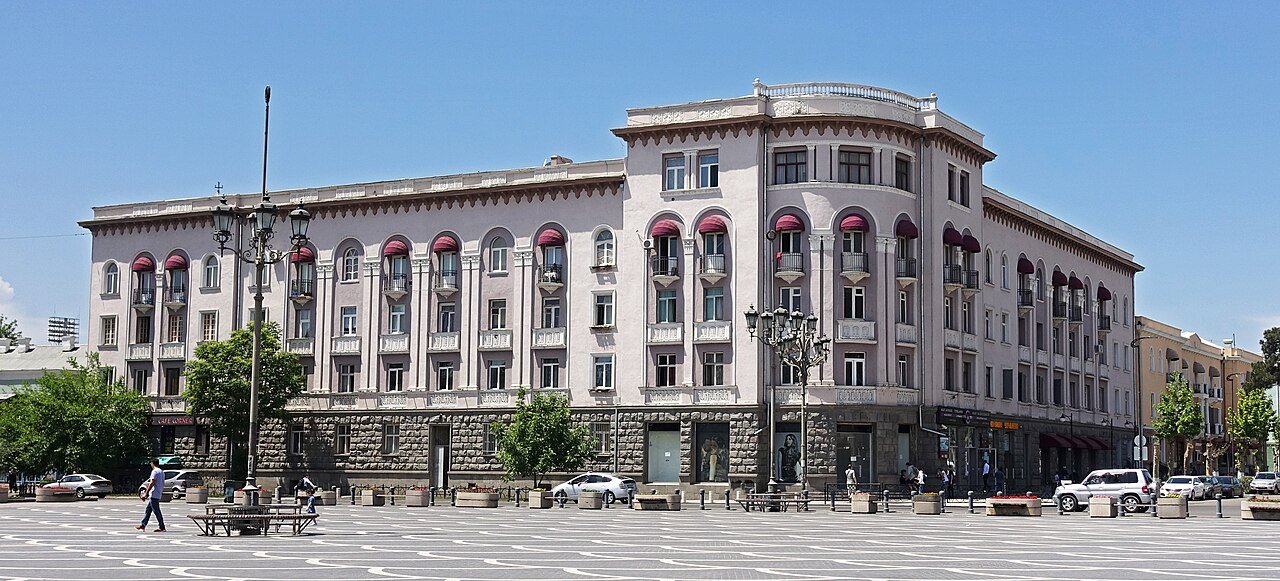
About the District
Old Rustavi is historically the first part of the city, with denser development and Soviet-era ("panel") housing stock. Prices here are lower than in New Rustavi, but in blocks adjacent to industrial facilities, air quality is rated as more of a concern — worth factoring in when choosing a specific building, not just the district as a whole.
History and character
Rustavi is ancient: a bishopric was set up here under Vakhtang Gorgasali in the 5th century, David the Builder took the town in 1115 and the Mongols destroyed it in 1265. The modern city was laid out in 1944 beside the metallurgical plant (built 1941–1950) and became a town of republican importance on 19 January 1948. German prisoners of war helped build it, and workers came from across Georgia.
Per Georgian Wikipedia, Old Rustavi is the left-bank part, with industry, administration and the station. It is Stalinist Empire style, not panel blocks; those began going up in 1955 on the other bank, in New Rustavi.
What to see
A walk through the centre covers it.
- The Stalinist Empire ensemble — the mayor's office, the drama theatre (opened 30 November 1967), the music school and the station.
- Rustavi Fortress — walls of three periods, 5th–13th century; Georgian Wikipedia calls it the only fortress in Georgia with frescoes.
- Rustavi History Museum — opened in 1950, about 23,600 items; closed Mondays.
- Soviet mosaics on science and industry, and 2019 murals by the Niko Project.
Life and economy
The anchor is the steel plant: about 15,000 people worked there at its peak, about 1,200 now. The Azot plant has operated since 1960. After 1991, Wikipedia says, 65% of residents lost their jobs. Tbilisi is about 25 km away, 30–50 minutes by minibus. Sources mention a city festival, Rustavi Kalakoba.
Housing market: what is known and what is not
There is no public price data for Old Rustavi. Broker reviews quote city-wide ranges without method or date, so I do not repeat them. I found no air-quality measurements by neighbourhood; industry is nearby, so check the building's position. Check in advance:
- distance from the building to plant zones and main roads;
- the state of the facade, roof and shared utilities;
- how the building is managed;
- what comparable flats in the same block are asking.
Frequently Asked Questions
What is there to see in Old Rustavi?
The Stalinist ensemble with the mayor's office and theatre, Rustavi Fortress, the history museum and Soviet mosaics.
How does Old Rustavi differ from New Rustavi?
Old Rustavi was planned in 1944 on the left bank of the Mtkvari: industry, administration, Stalinist Empire style. New Rustavi was built from 1955 on the right bank as microdistricts of block housing.
Can I buy a flat in Old Rustavi?
There is no open data on prices or deals. The general procedure is on the "How buying works" and "Property taxes" pages; have a specific flat checked by a local lawyer.
Sources: Wikipedia (en): Rustavi · Wikipedia (ru): Rustavi · Wikipedia (ka): Rustavi · Wander-Lush: things to do in Rustavi · OnlyByLand: Rustavi, Georgia · Tbilisi Trip: Rustavi and industrial Georgia · CityPopulation.de (Geostat census 2024): cities of Georgia
Other Rustavi Districts
Before you buy
Rules that apply across Georgia, whichever city you pick:
Market news · Old Rustavi
A short summary of publications from open sources, prepared with AI; not legal or financial advice. Please check the original source.